Introduction
For any extrusion plant—whether you are producing PVC pipes, blown film, or profile sheets—stability is currency.
A common nightmare for plant managers is “Surging.” This occurs when the extruder RPM remains constant, but the output at the die fluctuates. This leads to dimensional variations, uneven wall thickness, and ultimately, high scrap rates.
While many operators blame the motor or the temperature controller, 70% of output instability issues are directly related to the Screw and Barrel condition or design.
In this article, we will analyze the technical root causes of surging and provide specific parameters to help you diagnose the issue.
1. Screw & Barrel Wear (The #1 Culprit)
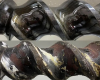
As the screw rotates, the flight land rubs against the barrel wall. Over time, this clearance increases. When the gap becomes too large, it causes Melt Backflow (leakage over the flights). The pressure builds up, the melt slips back, and then surges forward unpredictably.
Technical Parameter Check:
- Standard Clearance: For a new machine, the radial clearance between the screw flight and barrel is typically 0.002 times the bore diameter.
- Example: For a 90mm extruder, the standard gap is approx. $0.18mm$.
- The Danger Zone: If the wear gap exceeds 0.50mm (0.020 inches), the backflow becomes significant. This can reduce output by 15% to 20% at the same RPM.
The Fix:
Perform a “Push-Out” inspection. If wear is detected, simply increasing RPM will only increase melt temperature, not stability. You need to refurbish the barrel or switch to a Bimetallic Screw (armored with Tungsten Carbide) to restore pressure stability.
2. Incorrect Compression Ratio (Design Mismatch)
Many factories change resin formulations (e.g., adding high loads of CaCO3 filler or switching from virgin to recycled material) but continue using a General Purpose (GP) Screw.
A GP screw typically has a Compression Ratio (CR) of 2.5:1. However, different materials behave differently:
- Low Bulk Density materials (like fluff or recycled film) require a higher CR (e.g., 3.5:1) to compact the material effectively.
- Heat-sensitive materials (like rigid PVC) require a lower CR (e.g., 2.2:1) to prevent degradation.
The Symptom:
If the screw design doesn’t match the material, you will see “Air Entrapment” (bubbles in the melt) or uneven plasticization, causing the amperage (load) on the motor to fluctuate wildly.
3. Feed Throat Temperature Issues (Bridging)
Before the plastic even melts, it must be conveyed. If the Feed Zone of the barrel is too hot, the pellets or powder will stick together before they are compressed. This forms a “Bridge” or solid ring that blocks new material from entering.
Recommended Parameters:
- The Feed Throat temperature should be maintained between 40°C and 60°C.
- Check your water cooling jacket. If the return water is hot to the touch ($>60^\circ C$), your cooling channels are likely blocked with scale/rust.
4. Poor Mixing Design (Melt Fracture)
For modern extrusion, a simple 3-zone screw (Feed, Compression, Metering) is often insufficient. If the melt is not homogenized, colder material mixes with hotter material, creating viscosity differences that manifest as surging at the die.
The Solution:
We recommend upgrading to a Barrier Screw or adding a Maddock / Egan Mixing Section.
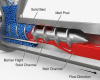
- How it works: A barrier flight separates the solid bed from the melt pool. This ensures that only fully melted plastic can pass over the barrier into the metering section, guaranteeing 100% melt uniformity.
Case Study: How We Solved a 15% Output Fluctuation
To prove the importance of customized design, here is a recent case from one of our clients.
Client: A manufacturer of HDPE water pipes.
The Problem:
They were using a standard single screw extruder ($\phi 120mm$). When they increased the percentage of recycled material (Regrind) to 30%, the pipe wall thickness began to fluctuate. The output surged by $\pm 15\%$, forcing them to slow down the line speed significantly.
Our Diagnosis:
We analyzed their screw and found it was a standard GP screw with a shallow feed depth ($12mm$). It physically could not “grab” the lightweight recycled flakes fast enough.
Our Solution:
We designed and manufactured a custom High-Performance Barrier Screw:
- Deepened the Feed Depth: Increased from $12mm \rightarrow 16mm$ to increase conveying volume.
- Added a Shear Mixing Section: To break down the inconsistent recycled particles.
- Material Upgrade: Used SKD61 steel with bimetallic alloy spraying for wear resistance against the dirty recycled material.
The Result:
- Stability: Output fluctuation dropped to less than 1%.
- Capacity: They were able to run the line at max speed, increasing daily production by 22%.
- ROI: The cost of the new screw was recovered in just 3 weeks of production.
If your extruder is surging, don’t just adjust the PID controller and hope for the best. The root cause is likely mechanical.
Is your screw worn out? Is your compression ratio correct for your current material?
At [Your Factory Name], we don’t just sell screws; we provide Extrusion Solutions. We can reverse-engineer your worn screw or design a new geometry specifically for your material formula.
Call to Action:
Stop wasting material. Contact us today for a Free Screw Design Analysis. Send us your screw diameter and material type, and our engineers will provide a verified solution within 24 hours.