Case Study: Transforming PVC Pellet Production in Southeast Asia
How Customized Material Science Turned a Production Nightmare into a Competitive Advantage
1. The Challenge: A Crisis of Efficiency and Durability
In the rapidly expanding plastics market of Southeast Asia, a prominent manufacturer specializing in PVC (Polyvinyl Chloride) plastic pellets found themselves trapped in a production crisis. Despite strong market demand, their factory floor was struggling with two critical bottlenecks that threatened their profitability and reputation.
The “Double-Pass” Plasticization Nightmare The first, and most costly issue, was poor plasticization. PVC is a thermally sensitive material that requires precise temperature control and shear force to melt uniformly. However, the client’s existing extruders were failing to achieve a homogeneous melt. The raw material would exit the die head containing unmelted particles (“fish eyes”) and inconsistent density.
To salvage production, the client was forced to implement a highly inefficient “Secondary Processing” protocol. They had to run the raw material through one machine to achieve a semi-molten state, collect it, and then feed it into a second machine to finally form usable pellets.
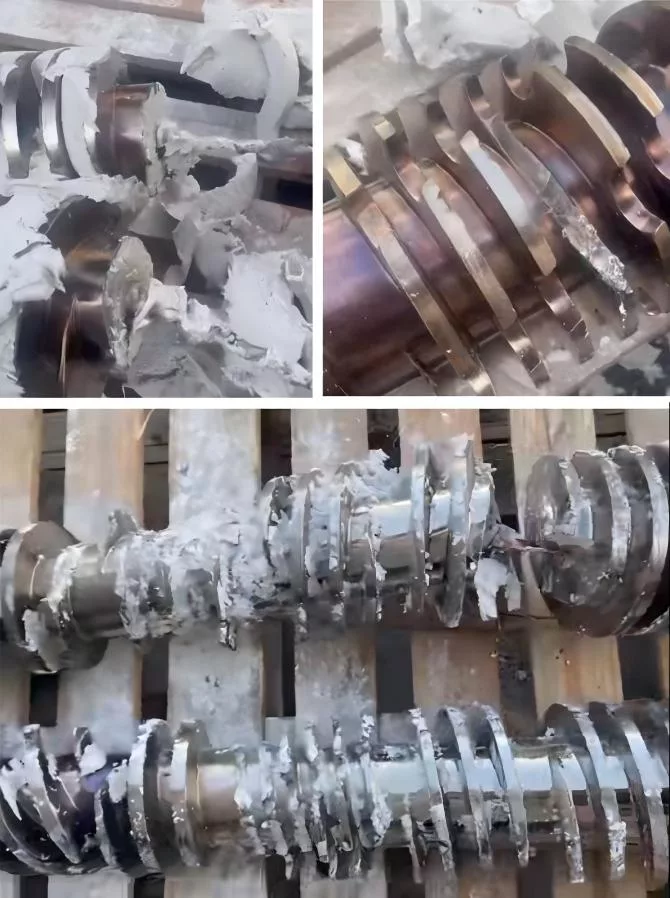
The Plague of Screw Breakage Compounding the efficiency issue was a severe mechanical failure: Screw Breakage. The screws provided by their previous supplier were snapping with alarming frequency. In the extrusion industry, a broken screw is catastrophic—it halts production instantly, risks damaging the expensive barrel, and leads to weeks of unplanned downtime waiting for replacements. The client’s maintenance team was in a constant state of anxiety, never knowing when the next failure would occur.
2. The Diagnosis: Uncovering the “Generic” Trap
When BLOOM was invited to consult, we didn’t just offer a catalogue product. We initiated a deep-dive technical audit. Through extensive communication with the client’s engineers, we analyzed their PVC formulations, operating temperatures, and screw speeds.
The Root Cause Identified Our investigation revealed a shocking mismatch: The previous supplier had provided screws designed for General PVC Pipe Production, not for Pelletizing.
While both processes use PVC, the rheological requirements are polar opposites:
-
Pipe Screws: Rely on high pressure and short compression zones to shape rigid pipes.
-
Pelletizing Screws: Require excellent mixing, lower pressure, and gentle shear to ensure every pellet is uniform.
By using a “Pipe Structure” for pelletizing, the screw was generating excessive shear stress in the wrong zones. This caused the material to degrade (burn) or pass through unmelted, while the high torque resistance required to force the material through exceeded the yield strength of the steel, causing the screws to snap. The client wasn’t suffering from bad luck; they were victims of mismatched engineering.
3. The Solution: Tailored Engineering & Material R&D
BLOOM proposed a radical departure from the client’s current setup. We didn’t just tweak the existing design; we re-engineered the core component based on our “Material First” philosophy.
Design Innovation: The Extended Plasticizing Zone We recommended a custom screw geometry featuring a significantly longer plasticizing area (L/D Ratio Optimization).
-
The Logic: By elongating the melting zone, we increased the residence time of the material inside the barrel. This allowed for a gentler, more gradual heat transfer.
-
The Benefit: The PVC could melt completely and uniformly without the high shear spikes that cause degradation. This promised to eliminate the need for the “second pass” entirely.
Material Science: Specialized Alloy Armor To address the breakage and wear issues, standard steel was insufficient. We utilized a specialized bi-metallic alloy developed in our R&D labs.
-
Wear Resistance: The alloy was formulated to resist the abrasive nature of the mineral fillers in the client’s PVC compound.
-
Corrosion Resistance: It was chemically balanced to withstand the hydrochloric acid (HCl) gas often released during PVC processing, preventing the micro-cracking that leads to snapping.
4. The Validation: Seeing is Believing
The proposal was technically sound, but the client, having been burned by previous suppliers, remained cautious. To bridge this gap of trust, they decided to fly to our headquarters for an On-Site Inspection.
The Factory Tour This visit became the turning point. We moved beyond conference room slides and walked them onto the factory floor. The client witnessed:
-
Real-World Production Scenarios: We simulated their operating conditions on our test lines.
-
Precision Manufacturing: They saw our CNC machining centers operating with micron-level tolerance, ensuring the “Extended Plasticizing Zone” was machined exactly to design.
-
Quality Assurance: We demonstrated our metallurgical testing process, proving that our “Alloy” claims were backed by rigorous data, not just marketing.
The transparency of our operations and the visible quality of our manufacturing process dismantled their skepticism. They realized BLOOM was not just a vendor, but a technical partner.
5. The Result: From Trial to Transformation
The client placed an initial order for one single set of the BLOOM customized screw and barrel to test on their most problematic line.
The Trial Run The results were immediate and transformative.
-
Efficiency: The new screw achieved 100% plasticization in a single pass. The “Machine B” (secondary processing) was turned off, instantly slashing energy costs by 50%.
-
Quality: The pellets were uniform, free of “fish eyes,” and met the highest market standards.
-
Durability: After months of continuous operation, the screw showed negligible wear and zero signs of fatigue or breakage.
Scaling Up The Return on Investment (ROI) was undeniable. Recognizing the competitive advantage BLOOM’s technology provided, the partnership rapidly expanded. The client moved from a single trial order to a strategic overhaul, placing a bulk order for nine additional sets at once to retrofit their entire fleet.
Today, this Southeast Asian manufacturer operates with restored confidence. The production bottlenecks are gone, replaced by a streamlined, high-efficiency process. This case stands as a testament to BLOOM’s core belief: When you start with Material R&D and tailor the solution to the scenario, even the toughest production challenges can be solved.