
In industries such as chemical processing, metallurgy, and environmental protection, the demands placed on materials under extreme conditions never cease escalating. Facing complex environments where strong acid corrosion coexists with physical wear, traditional single-solution materials often struggle to cope. At our company, we have always upheld the core philosophy that continuous innovation and research and development constitute our foundation, dedicating ourselves to solving these industry pain points.
It is this commitment to R&D that drove us to successfully develop the latest generation nickel-based alloy material—OS02M. Designed specifically for the strong acid industry, this material aims to break the compromise traditionally required between corrosion resistance and wear resistance, providing a new, uncompromising choice for demanding application scenarios.
The Challenge: When Corrosion Meets Wear
When handling strong acid media containing solid particles (such as hydrofluoric acid slurry or acidic mine slurry containing chloride ions), equipment components face a double blow:
- Chemical Corrosion: Strong acid media continuously erode the material matrix.
- Mechanical Abrasion: Solid particles suspended in the fluid scour and grind the material surface.
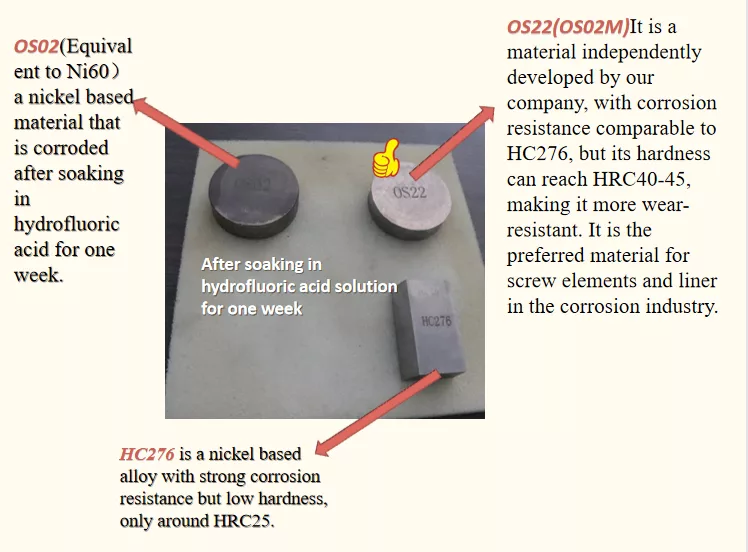
While industry benchmark materials like Hastelloy C-276 (HC276) excel in corrosion resistance, their relatively low hardness becomes a significant shortcoming in high-wear environments, leading to shortened equipment lifespan and soaring maintenance costs.
The Solution: OS02M Nickel-Based Alloy
The design intent of OS02M is very clear: to significantly improve material hardness and resistance to abrasive wear while providing excellent corrosion resistance comparable to HC276. It is not merely a minor adjustment to existing materials, but a precise targeting of specific industrial needs.
1. Deep Dive into Chemical Composition: The Cornerstone of Corrosion Resistance
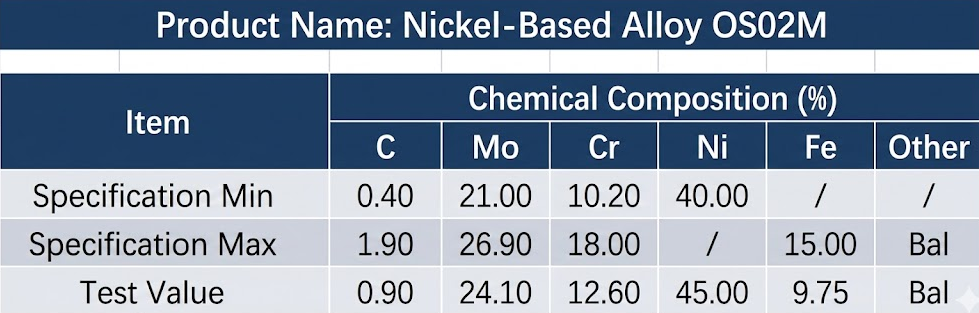
OS02M’s exceptional corrosion resistance stems from its carefully formulated chemical composition. As shown below, the material utilizes a high-nickel base supplemented by extremely high molybdenum (Mo) content.
Table 1: OS02M Nickel-Based Alloy Chemical Composition Analysis (Product Name: Nickel base alloy OS02M)
(Note: Data based on provided test specifications)
| Item | C (%) | Mo (%) | Cr (%) | Ni (%) | Fe (%) | Other |
| Spec Min/Max | 0.40 – 1.90 | 21.00 – 26.90 | 10.20 – 18.00 | ≥ 40.00 | ≤ 15.00 | Balance |
| Test Value | 0.90 | 24.10 | 12.60 | 45.00 | 9.75 | Balance |
- High Molybdenum (Mo) Content (Tested 24.10%): This is the core core of OS02M’s corrosion resistance. In materials science, molybdenum is one of the most effective elements for improving resistance to pitting and crevice corrosion in reducing acids (such as hydrochloric acid and hydrofluoric acid). A molybdenum content as high as 24% ensures OS02M has the foundation to stand alongside top-tier corrosion-resistant alloys in extreme acidic environments.
- Chromium (Cr) and Nickel (Ni) Base: The 45% nickel base provides a stable austenitic structure and overall corrosion resistance, while 12.6% chromium provides necessary oxidation resistance.
2. Breakthrough in Physical Properties: A Qualitative Leap in Hardness
The initial claim that “the hardness of OS02M has been increased by two” is concretely reflected in its technical parameters.
Standard HC276 alloy in solution annealed condition typically has low hardness (approx. 85-95 HRB, which converts to below 20 HRC on the Rockwell C scale; cold working can increase this but only partially). For high-wear conditions, this hardness is clearly insufficient.
OS02M achieves a leap in hardness through unique alloying design and process control:
Table 2: OS02M Key Physical and Process Parameters
| Parameter Name | Technical Specification | Application Significance |
| Alloy Layer Hardness | 40 – 45 HRC | Compared to standard state HC276, this represents a qualitative improvement in hardness. High hardness directly translates into excellent resistance to abrasive wear and erosion-corrosion, making it ideal for dynamic components like slurry pumps, valves, and agitators. |
| Temperature Resistance Limit | 600℃ | Covers the operating temperature range of most hydrometallurgy and chemical processes, maintaining stable performance in high-temperature acidic environments. |
| Alloy Layer Thickness | ≧2mm | Provides a sufficient “sacrificial layer” to ensure adequate service life under long-term wear and corrosion, extending equipment overhaul cycles. |
Core Application: Replacing HC276, Conquering Hydrofluoric Acid Conditions
Based on the characteristics above, the primary application target for OS02M is replacing HC276, especially in scenarios where HC276 fails prematurely due to wear.
Special Focus: Hydrofluoric Acid (HF) Corrosion
Hydrofluoric acid is one of the most difficult media to handle in industry, as it is highly corrosive to many metals and almost all glass/ceramics. HC276 is often the preferred material for handling HF. However, when the HF medium contains solid particles (such as mineral slurry in fluorination processes), the synergistic effect of corrosion and wear significantly accelerates material failure.
With its high molybdenum content (anti-HF corrosion) and 40-45 HRC high hardness (anti-particle abrasion), OS02M has become the optimal solution for coping with hydrofluoric acid conditions containing solid particles.
Conclusion
We firmly believe that innovation and research and development are the lifeblood of our company. The advent of OS02M is our practice of this belief. Through deep exploration of materials science, we have successfully fused superior corrosion resistance with high wear resistance into a single material.
We will continue to dedicate ourselves to technical improvement, maintaining industry leadership, and ensuring we provide our customers with the highest quality, most reliable products, helping customers achieve cost reduction and efficiency increases in the harshest production environments.