
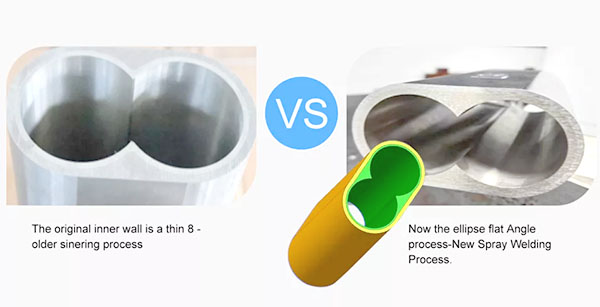
In the demanding field of plastics compounding, barrel wear is the primary driver of performance degradation and costly downtime. We are proud to announce a significant leap forward in wear-protection technology with the development of our new Spray Welded Composite Liner, featuring the proprietary Nickel-Base Alloy OS02H. Engineered specifically for parallel twin-screw extruders processing highly abrasive and corrosive materials, this new liner technology has been proven to extend service life by 300% to 500% compared to conventional solutions.
This article delves into the metallurgical innovations, process technologies, and comparative performance data that validate OS02H as a new industry benchmark.
1. The Challenge: Combating Extreme Wear and Corrosion
Twin-screw extrusion of highly filled polymers (e.g., glass fiber, mineral fillers like CaCO3, TiO2) and corrosive resins (e.g., fluoropolymers, PVC, halogenated flame retardants) creates an aggressively hostile environment inside the barrel.
- Abrasion: Hard fillers act like a grinding paste, rapidly eroding the barrel surface, increasing screw-to-barrel clearance, and destroying conveying efficiency.
- Corrosion: Acidic byproducts from polymer degradation or additives attack the metal matrix, causing pitting and accelerating abrasive wear.
Conventional nitrided steel barrels, with a thin hardened layer (typically 0.3mm – 0.6mm) and moderate hardness (~900-1000 HV, approx. 67 HRC but very brittle and thin), often fail prematurely under these conditions. Once the thin nitride layer is breached, the softer base metal wears away catastrophically.
2. The Solution: OS02H – A Triumph of Metallurgy and Process Engineering
Our solution is a composite liner system that utilizes a high-performance nickel-base alloy, applied through an advanced spray welding process.
2.1 Advanced Process: Spray Welded vs. Sintered
Unlike traditional centrifugal casting or vacuum sintering powder metallurgy processes, our Spray Welding technique creates a superior protective layer. This process involves spraying the alloy powder onto the substrate and simultaneously fusing it using a high-heat source.
- Metallurgical Bond: The process creates a true metallurgical bond between the alloy liner and the steel backing, ensuring exceptional adhesion strength that eliminates the risk of delamination under high shear stress.
- Superior Microstructure: As highlighted in our internal studies, compared to our previous vacuum-sintered alloy (OS02), the spray-welded OS02H exhibits significantly improved compactness. The rapid solidification inherent in the process results in a finer, more detailed metallographic structure. A finer grain structure directly correlates to improved toughness and wear resistance.
2.2 Metallurgical Design: The OS02H Alloy Chemistry
The chemical composition of OS02H has been meticulously balanced to create a material that is both extremely hard and highly corrosion-resistant.
Table 1: OS02H Chemical Composition & Functional Role
| Element | Composition (%) | Functional Role in the Alloy Matrix |
| Nickel (Ni) | Balance (~53%) | The Matrix Foundation: Provides excellent ductility, toughness, and inherent resistance to reducing acids and stress corrosion cracking. It holds the hard carbides firmly in place. |
| Chromium (Cr) | 16.5% | Dual Purpose: Forms hard chromium carbides for wear resistance and creates a stable passive oxide layer for premier corrosion resistance against oxidizing media. |
| Molybdenum (Mo) | 9.5% | Corrosion Booster: Significantly enhances resistance to pitting and crevice corrosion, particularly in chloride-containing environments (common with certain additives or PVC). |
| Tungsten (W) | 4.5% | Extreme Hardness: Forms extremely hard, thermally stable tungsten carbides, providing the primary defense against severe abrasive wear from glass fibers and mineral fillers. |
| Silicon (Si) | 3.5% | Process Aid & Hardener: Acts as a deoxidizer during welding and promotes the formation of hard silicide phases, further increasing overall hardness. |
| Boron (B) | 3.0% | Fluxing Agent & Hardener: Lowers the melting point for effective spray welding and forms extremely hard borides, contributing significantly to the alloy’s high hardness. |
| Carbon (C) | 1.5% | Carbide Former: Combines with Cr, W, and Mo to form a high volume fraction of intensely hard carbide phases. |
The Key Differentiator: The user-reported breakthrough is a direct result of a “significant increase in hard wear-resistant phase carbides” within a denser nickel matrix. This engineered microstructure allows OS02H to achieve twice the wear resistance of previous generation vacuum-sintered alloys in standardized grinding tests.
3. Comparative Performance & Industry Benchmarking
To understand the value of OS02H, it must be compared against existing market solutions. We benchmarked OS02H against standard nitrided steel and published specifications for high-end bimetallic alloys from leading global competitors.
Table 2: Technical Parameter Comparison
| Feature | Standard Nitrided Steel Barrel | Typical Competitor High-End Ni-Base Alloy | Our New OS02H Spray Welded Liner | Competitive Advantage |
| Primary Wear Mechanism | Surface Hardening (Nitriding) | Hard Carbides in Nickel Matrix | Dense Hard Carbides in Nickel Matrix | Similar mechanism to top-tier competitors, far superior to nitriding. |
| Layer Hardness (HRC) | ~65-70 (Surface only) | 58 – 64 HRC | 57 – 64 HRC | On par with the world’s best. Provides extreme resistance to abrasive particle ploughing. |
| Service Layer Thickness | 0.3mm – 0.6mm | 1.0mm – 1.5mm | ≧ 1.8mm | Superior Thickness. OS02H offers a 20%-80% thicker wearable life layer than many high-end competitors, directly translating to longer service life. |
| Max. Operating Temp. | ~450°C – 500°C | ~500°C – 600°C | 600°C | Excellent thermal stability for processing high-temperature engineering plastics (e.g., PEEK, PSU). |
| Corrosion Resistance | Poor to Moderate | Excellent | Excellent | High Ni-Cr-Mo chemistry ensures long-term survival in aggressive chemical environments. |
| Estimated Lifespan Multiplier | 1x (Baseline) | 3x – 4x | 3x – 5x | The combination of high hardness, a denser microstructure, and a thicker service layer supports this significant lifespan extension. |
Note: Competitor data is based on publicly available specifications for premium nickel-based bimetallic alloys used in similar applications.
The comparative grinding test data (as seen in your original announcement chart) visually confirms this hierarchy, showing OS02H with significantly lower weight loss compared to standard materials and even previous generation alloys.
4. Structural Innovation: The Elliptical Advantage
Beyond material science, we have optimized the physical design of the liner for large-format extruders (Type 65 and larger).
- Legacy Design: Traditional “8-shaped” liners can have sharp internal corners. These are stress concentration points that can lead to cracking under high torque and thermal cycling.
- OS02H Innovation: We have transitioned to a “waist-shaped elliptical 8-shaped alloy layer.” This smoother geometric profile eliminates stress risers, providing better structural support and enhanced resistance to wear at critical transition zones in the barrel’s cross-section.
Conclusion
The OS02H Spray Welded Composite Liner is not just an incremental improvement; it is a re-engineering of wear protection for twin-screw extrusion. By combining an advanced, carbide-rich nickel alloy chemistry with a superior spray welding process and an optimized structural design, we have created a product that directly addresses the industry’s most critical pain points.
With a service layer that is harder, denser, and thicker than conventional alternatives, OS02H delivers a proven 3-5 times increase in lifespan, offering our customers unbeatable value through maximized production uptime and the lowest total cost of ownership.